



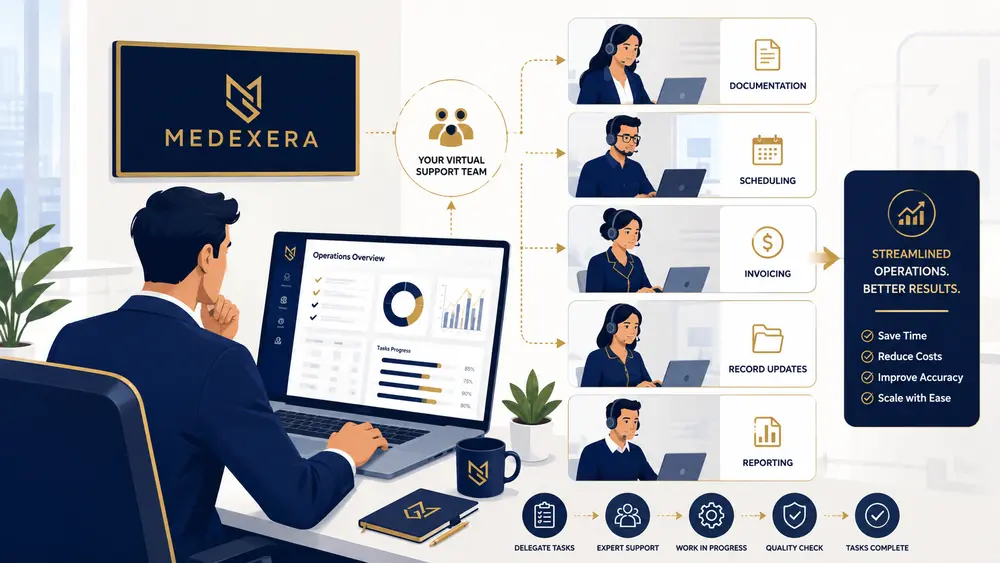
When a business is growing, administrative work tends to grow alongside it. Scheduling piles up. Follow-up tasks fall through gaps. Document handling gets passed between whoever has time. And before long, your internal team is spending a significant part of every week on work that keeps the business running but does nothing to move it forward.
Learning how to outsource administrative tasks is one of the more practical decisions a growing business can make. Done with structure, it frees your internal team to focus on the work that actually requires their judgment, while the recurring operational tasks get handled consistently and on time.
This article covers which administrative tasks are worth outsourcing first, how to recognize when your business is ready, what structured virtual operations support looks like in practice, and how to make the transition without losing visibility into your workflows.
Send Us Message
Strong communication teamwork skills enable collaboration
Which Administrative Tasks Are Worth Outsourcing First?
Not every administrative task is equally well-suited for outsourcing, but a large number of them are. The best candidates share common traits: they are recurring, process-driven, and do not require deep institutional judgment to complete correctly.
Scheduling and Calendar Management
Appointment scheduling, meeting coordination, reschedule management, and reminder workflows are among the most commonly outsourced administrative tasks. They require consistency and responsiveness, but they do not require someone with full knowledge of your business strategy. When this work is handled by a dedicated support resource, it gets done reliably and does not compete for attention with higher-priority internal work.
Communication Follow-Up and Coordination
Follow-up communication is one of the most significant sources of administrative backlog in growing businesses. Unresponded messages, pending requests, and outstanding action items accumulate quickly when there is no dedicated process to manage them. Outsourcing communication coordination means a structured resource is monitoring, flagging, and following up on these items consistently, rather than waiting for someone internally to find time.
Document Handling and Workflow Management
Document coordination tasks, including organizing records, routing documents through review processes, maintaining filing systems, and tracking document status, are well-suited for outsourced support. These tasks need to be done carefully and consistently, but they can be handled by a trained external team with a clear process in place. Businesses that invest in documentation and data processing support typically see fewer errors and faster turnaround on document-dependent workflows.
Data Entry and Records Processing
High-volume data entry, records updates, and database maintenance are among the tasks most commonly delegated to external support. They are time-intensive, require accuracy, and take internal team members away from work that needs their direct involvement. Structured support handles these tasks at volume without the overhead of a dedicated in-house hire.
If your business also handles billing operations internally, invoice data entry and payment records management can often be transitioned alongside other administrative tasks as part of a broader workflow handoff.
How Do You Know When Your Business Is Ready to Outsource Admin Work?
The decision to outsource administrative tasks is usually less about scale and more about strain. Businesses do not need to reach a particular headcount or revenue threshold before outsourcing makes sense. They need to reach the point where internal admin work is consistently pulling team members away from work that requires their judgment.
Signs Your Internal Team Is Absorbing Too Much Admin
The clearest indicator is when your team members spend more time managing administrative follow-through than they do on the work they were actually hired to do. Other signs include missed follow-ups that only get addressed reactively, documents or records that fall behind because no one has time to process them consistently, and scheduling or coordination tasks that default to whoever is available rather than a structured process.
When these patterns become routine rather than occasional, the cost of keeping administration in-house begins to exceed the cost of structured external support.
The Cost of Keeping It In-House Too Long
Administrative backlog has a compounding effect. A missed follow-up becomes a delayed decision. A disorganized document process creates compliance exposure. A scheduling gap delays a client interaction. None of these feel catastrophic individually, but together they create operational drag that slows a growing business down at exactly the wrong time.
According to research from Deloitte, companies typically see cost savings of 20 to 40% compared to in-house administrative staffing when they transition to structured outsourcing. The savings are relevant, but for most businesses, the primary benefit is recovered team capacity and improved consistency across recurring workflows.
Tell Us About Your Current Workflows
What Does Outsourced Virtual Operations Support Actually Look Like?
Many business owners hesitate to outsource administrative tasks because they are not sure what the day-to-day arrangement looks like. The concern is reasonable. Handing off recurring tasks to an external team requires clarity about process, communication, and accountability.
Structured virtual operations support is not a general-purpose virtual assistant arrangement. It is a defined support model built around specific operational workflows, with clear scope, structured handoffs, and consistent follow-through.
What a Structured Support Model Covers
A well-designed virtual operations support engagement typically covers scheduling and calendar management, communication and follow-up workflows, document handling and records coordination, and task tracking across recurring operational activities. The scope is agreed on upfront, so both parties have clear expectations about what is handled, at what frequency, and to what standard.
This model can also extend into business onboarding support for businesses managing new client or vendor setup processes, where the administrative requirements are significant and benefit from dedicated process handling.
How Handoff and Coordination Work in Practice
The transition typically begins with a workflow mapping phase, where the support team documents the current state of the tasks being handed off, identifies any gaps or inconsistencies, and establishes the process that will govern ongoing delivery. This phase usually takes one to two weeks for standard administrative workflows.
Once the process is in place, the support team operates within it, reporting back on activity, flagging exceptions, and escalating only what genuinely requires internal decision-making. The result is that internal team members stay informed without being pulled into the day-to-day execution of administrative tasks.
What Are the Risks of Outsourcing Administrative Tasks, and How Do You Manage Them?
Outsourcing administrative tasks is not without risk, but the risks are manageable when the engagement is structured correctly. Most problems that arise stem from unclear scope, poor communication expectations, or choosing a provider without a defined process.
Maintaining Quality and Consistency
The most common concern is whether an external team will handle tasks to the same standard as an in-house employee. The answer depends largely on how clearly the process is defined. When workflows are documented, outputs are measurable, and the support team has a clear standard to work to, quality can be maintained consistently. Regular check-ins and output reviews during the early months of an engagement are a straightforward way to confirm that standards are being met.
Communication and Visibility Expectations
Outsourcing administrative tasks does not mean losing visibility into what is happening. A structured engagement should include regular reporting on task activity, clear escalation paths for exceptions, and a defined communication cadence between your internal point of contact and the support team. Businesses that establish these expectations at the start of an engagement typically find that they have better visibility into their administrative workflows than they did when those tasks were being handled informally in-house.
How Does Medexera Approach Virtual Operations Support for U.S. Businesses?
Medexera provides structured operational support for growing U.S. businesses that need more consistent handling of administrative and workflow tasks without the overhead of additional in-house headcount.
Our virtual operations support is built around specific workflow needs rather than generic task delegation. We work with each business to understand the current state of the administrative tasks being handed off, document the process, and deliver support with clear accountability and follow-through.
For businesses that need support across multiple operational functions, Medexera’s full range of support services covers billing operations, documentation and data processing, business onboarding, and payment recovery support, so operational support can be coordinated across functions rather than managed through separate providers.
The goal is not simply to take tasks off your team’s plate. It is to make sure those tasks get handled correctly, consistently, and with enough structure that your business can rely on them as a stable part of its operations.
Request an Operations Support Consultation
Is Outsourcing Administrative Tasks Right for Every Business?
Outsourcing administrative tasks works best for businesses that have enough recurring admin volume to justify a structured support arrangement, and enough process clarity to hand tasks off with confidence. It is not the right fit for businesses where every administrative task requires constant real-time judgment from internal leadership, or where workflows are too undefined to document reliably.
For most growing businesses in the $1M to $20M revenue range, the inflection point arrives when internal admin work starts competing with growth priorities. At that stage, structured external support is not a cost to minimize. It is a practical way to keep administrative work running correctly while internal capacity is directed toward the work that actually requires it.
If you are not sure whether your current workflows are ready for external support, the most useful first step is a straightforward conversation about what your team is currently handling and where the friction points are. You can reach our team at info@medexera.com or message us directly to start that conversation.
Outsourcing administrative tasks is not a shortcut. It is a structural decision that requires clear process documentation, defined expectations, and a support partner with genuine operational discipline. When those elements are in place, the results are consistent: internal teams recover time and capacity, administrative workflows become more reliable, and the business stops losing ground to the operational friction that comes with growth.
The businesses that benefit most are the ones that treat the transition as a process investment rather than a cost reduction. If your team is currently absorbing more administrative work than it should, structured virtual operations support is worth a serious look. Get in touch with Medexera to talk through where structured support can make the most immediate difference for your operations.
Send Us Message
Strong communication teamwork skills enable collaboration
FAQ
What administrative tasks can a small business realistically outsource?
Most recurring, process-driven administrative tasks can be outsourced effectively. This includes scheduling and calendar management, communication follow-up, document coordination, data entry and records processing, and workflow tracking. Tasks that require real-time strategic judgment or deep institutional knowledge are typically kept in-house, but a large proportion of day-to-day administrative work can be handled by a structured external support team.
How quickly can an outsourced operations team get up to speed?
For most standard administrative workflows, a structured onboarding and workflow documentation phase takes one to two weeks. After that, the support team operates within a defined process with clear expectations and reporting. More complex or multi-function engagements may take slightly longer to fully establish, but the transition is designed to be structured, not disruptive.
Will outsourcing admin tasks reduce visibility into our day-to-day workflows?
A well-structured engagement should improve visibility, not reduce it. When administrative tasks are handled through a defined process with regular reporting, escalation protocols, and a clear communication cadence, business owners and operations managers often find they have more reliable insight into workflow activity than they did when tasks were being managed informally by whoever had time.